

Loneliness has quietly become one of the most pressing public health concerns of our time. While it’s often thought of as a fleeting emotional state, research suggests something much deeper: for many people, loneliness is chronic, painful, and woven into the fabric of modern life.
Even more striking is this—loneliness isn’t simply about being alone. It’s about feeling unseen, unknown, or disconnected, even when surrounded by others.
What Is Loneliness, Really?
At its core, loneliness is the gap between the relationships we have and the relationships we long for. A person can have a partner, friends, coworkers—even a busy social life—and still feel profoundly alone.
Many describe loneliness as:
- Feeling like no one truly understands them
- Struggling to be their authentic self with others
- Experiencing a sense of emotional or even existential disconnection
This helps explain why loneliness can persist even in highly connected, socially active lives.
Who Is Most Affected?
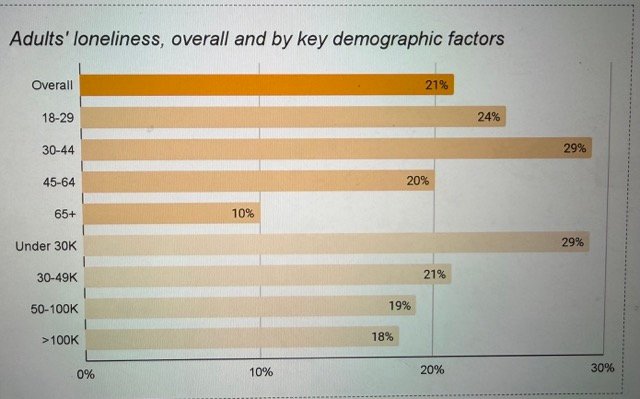
Loneliness is often associated with older adults, but current data challenges that assumption. In fact, middle-aged adults—particularly those in their 30s and early 40s—report some of the highest levels of loneliness.
This may reflect a stage of life marked by competing demands: careers, caregiving, financial pressure, and limited time for meaningful connection.
Loneliness also appears across all demographics. It is not confined to one gender, political group, or cultural background. While financial stress can increase vulnerability, the experience itself is widespread and deeply human. Below are a few charts showing important findings from the research study Loneliness in America: Just the Tip of the Iceberg?.
This is a chart from the study outlining percentages of loneliness by age range and then by income level.
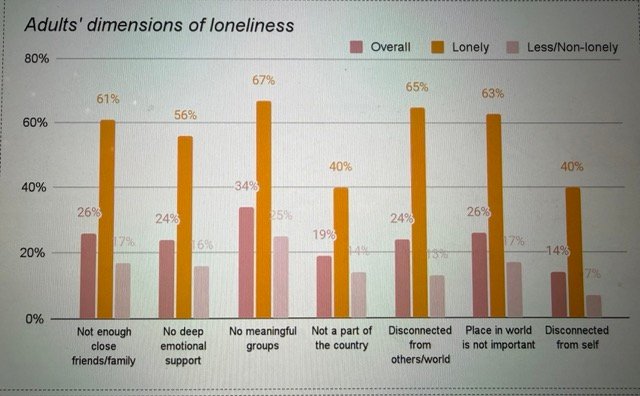
These are reported descriptions of what loneliness feels like.
The Mental Health Connection
Loneliness and mental health are closely intertwined. Individuals who report high levels of loneliness are significantly more likely to experience anxiety and depression. The study found higher reported levels of loneliness in people with anxiety and depression.
But this relationship is not one-directional. Loneliness can fuel mental health struggles, while anxiety and depression can make it harder to reach out, trust others, or maintain relationships. Over time, this creates a reinforcing cycle that can be difficult to break.
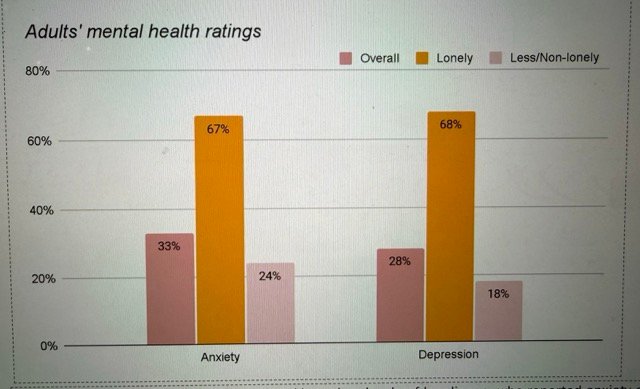
These are reported rates of loneliness for people meeting criteria for depression on the PHQ-9 questionnaire and anxiety based on the GAD-7 questionnaire.
What’s Driving the Loneliness Epidemic?
There is no single cause, but here are the six most highly reported reasons for loneliness from study participants.
1. Technology and Social Media – 73% of study participants
People often report that social media creates the illusion of community without offering true community. Someone can spend most of their time alone, just scrolling on social media and getting updates on what their friends and acquaintances are doing, but not interacting with them very much.
2. No family quality time – 66% of study participants
Many people feel that family members in the same home will become preoccupied with their own tasks or just get distracted by technology, and don’t spend quality time with each-other. People can sit in the same room without talking, each looking on their phones or watching TV.
3. Working too much – 62% of study participants
Many people are overworked and spread too thin between actual work hours, commuting, and household maintenance, leaving little room for genuine connection with loved ones around them.
4. Mental Health Barriers – 60% of study participants
Struggles like anxiety, depression, and low self-worth can make it harder to initiate or sustain relationships, even when the desire for connection is strong.
5. Cultural Individualism – 58% of study participants
Modern culture places a strong emphasis on independence and self-sufficiency. While empowering in some ways, this can discourage vulnerability and interdependence.
6. Lacking relationship skills – 57% of study participants
Many people report simply feeling unsure of how to start conversations with new people or even how to have deeper conversations with friends and family. People often grow up in homes where emotional vulnerability is not taught, so they learn to hold back and keep their true feelings to themselves. Over time, they struggle to be open with friends and relate only on a surface level.
What Actually Helps?
Addressing loneliness requires both individual and collective change.
On a personal level:
Make it a priority to learn to love yourself. What this means, ultimately, is to get to a place where you think that you are good enough just as you are. This does not mean giving up self-improvement. We all continue to learn and grow throughout our lives. However, it is important to get to a point where you accept yourself as a work in progress that is nonetheless lovable and worthy at every stage of the process.
Reach out in an open and genuine manner and Lean into authenticity — meaningful relationships require being seen as you are
Accepting yourself without reservation will allow you to feel safe being vulnerable. And being vulnerable is key to connection with other people. If you can be open and genuine, you have a chance of being truly seen and heard.
Engage in acts of care or service
Sometimes we forget that we are part of the fabric of humanity. Our thoughts, feelings, trials and tribulations are not unique – by far. The more you get to know the people around you, the more you will realize how universal our human condition is. By helping others in need, you will not only feel proud, but also connected and purposeful. Doing acts of service allows us to be vulnerable and to tune in to the vulnerability of those around us.
On a societal level:
We need to invest in community spaces where people can gather and interact.
We need to create cultures of care in workplaces, schools, and neighborhoods.
We should do our best to encourage meaningful interaction, not just surface-level contact.
A Different Way to Think About Connection
One of the most important insights is this: connection is not just about proximity—it’s about meaning. Simply being around people is not enough. What matters is whether we feel known, valued, and able to show up as ourselves.
In that sense, the solution to loneliness is not just “more socializing.” It’s deeper, more intentional, more human connection.
Final Thoughts
The loneliness epidemic is not a personal failure—it’s a reflection of how our society is structured and how our lives are organized. Recognizing this can reduce shame and open the door to change.
Rebuilding connection doesn’t require dramatic transformation. It often begins with small, deliberate steps: a conversation, a moment of honesty, an act of care.
Over time, those moments can become something more—relationships that feel real, sustaining, and deeply human.
**This blog is based on this article by Elizabeth Ross at the Harvard Graduate School of Education: https://www.gse.harvard.edu/ideas/usable-knowledge/24/10/what-causing-our-epidemic-loneliness-and-how-can-we-fix-it.**
Read the Surgeon General’s advisory on the loneliness epidemic here: https://www.hhs.gov/sites/default/files/surgeon-general-social-connection-advisory.pdf.